Exploring Bias and Equity in Artificial
Intelligence Systems: An Essential Concern



Artificial Intelligence
July 29, 2024 . 4 Min Read
Understanding bias in AI
As AI rapidly progresses, it brings both benefits and ethical challenges. From its early stages to today's advanced technology, AI has changed how we live and work. But it also raises concerns about privacy, bias, accountability, and transparency. To address these issues, collaboration across fields like computer science, ethics, law, and philosophy is crucial. Clear guidelines and regulations are needed to ensure AI serves humanity's best interests. Balancing innovation with ethical responsibility is key to maximizing AI's positive impact on society.
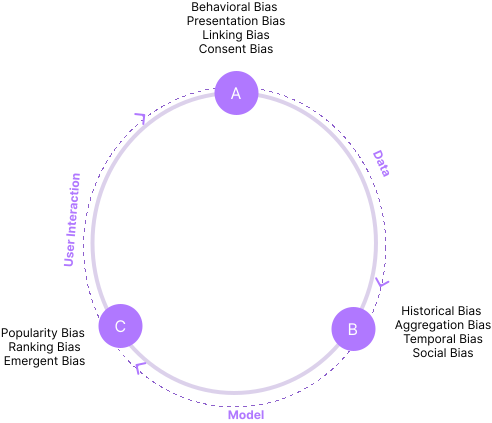
 Model bias pertains to prejudices ingrained within the structure or blueprint of an AI model. These biases stem from the algorithms employed, the characteristics chosen, or the presumptions taken in the model's creation. They can lead to consistent errors or imprecisions in the AI system's predictions or judgments. As an illustration, a facial recognition system predominantly trained on data from a specific demographic might struggle to identify faces from other demographics. This deficiency arises due to the model's limited exposure to varied data, thus hindering its capacity to accurately generalize across diverse populations.
- Data bias encompasses prejudices inherent in the datasets utilized for AI model development. These biases stem from diverse origins such as historical inequities, sampling discrepancies, or inaccuracies in data gathering and annotation. Consequently, AI systems may mirror and sustain prevailing societal biases and disparities. For instance, if a recruitment algorithm is trained on historical data that exhibits a bias towards particular demographic cohorts, the resultant AI system may perpetuate discrimination by consistently favoring those groups in recruitment processes.
- Human bias in the context of AI refers to the partialities introduced by individuals involved in creating, applying, and using AI technologies. These biases encompass subconscious tendencies, cognitive distortions, and preconceived notions. Throughout the AI system's lifecycle, human bias can influence decision-making, ranging from data collection and preprocessing to algorithm design and deployment. For example, a data scientist could inadvertently introduce bias into an AI model by prioritizing features that reflect their own biases or assumptions about the topic. Likewise, a programmer might unknowingly incorporate bias into an algorithm by choosing specific training data or optimization criteria.
Best Practices for Managing AI Bias and Ensuring Fairness
- Model bias pertains to prejudices ingrained within the structure or blueprint of an AI model. These biases stem from the algorithms employed, the characteristics chosen, or the presumptions taken in the model's creation. They can lead to consistent errors or imprecisions in the AI system's predictions or judgments. As an illustration, a facial recognition system predominantly trained on data from a specific demographic might struggle to identify faces from other demographics. This deficiency arises due to the model's limited exposure to varied data, thus hindering its capacity to accurately generalize across diverse populations.
- Data bias encompasses prejudices inherent in the datasets utilized for AI model development. These biases stem from diverse origins such as historical inequities, sampling discrepancies, or inaccuracies in data gathering and annotation. Consequently, AI systems may mirror and sustain prevailing societal biases and disparities. For instance, if a recruitment algorithm is trained on historical data that exhibits a bias towards particular demographic cohorts, the resultant AI system may perpetuate discrimination by consistently favoring those groups in recruitment processes.
- Human bias in the context of AI refers to the partialities introduced by individuals involved in creating, applying, and using AI technologies. These biases encompass subconscious tendencies, cognitive distortions, and preconceived notions. Throughout the AI system's lifecycle, human bias can influence decision-making, ranging from data collection and preprocessing to algorithm design and deployment. For example, a data scientist could inadvertently introduce bias into an AI model by prioritizing features that reflect their own biases or assumptions about the topic. Likewise, a programmer might unknowingly incorporate bias into an algorithm by choosing specific training data or optimization criteria.
Responsibilities of AI makers
As AI becomes increasingly integrated into our daily lives, individuals involved in handling data bear a significant responsibility to uphold ethical standards. This means prioritizing fairness, transparency, and accountability in their work to ensure that AI systems are developed and used in ways that promote the common good. To accomplish this, data professionals must actively seek out diverse perspectives, engage stakeholders, and consistently evaluate AI systems for potential biases and ethical concerns.
The notion of leveraging AI for societal benefit is an emerging area within AI ethics, with the aim of utilizing AI to address global challenges and improve societal and environmental well-being. At the heart of this effort is the creation and implementation of AI systems that benefit society as a whole, rather than just a select few. Fundamental principles of AI for societal benefit include inclusivity, sustainability, and designing technology with a focus on meeting human needs. By prioritizing these principles, AI developers can contribute to the development of a fairer and more sustainable future through technology.
The notion of leveraging AI for societal benefit is an emerging area within AI ethics, with the aim of utilizing AI to address global challenges and improve societal and environmental well-being. At the heart of this effort is the creation and implementation of AI systems that benefit society as a whole, rather than just a select few. Fundamental principles of AI for societal benefit include inclusivity, sustainability, and designing technology with a focus on meeting human needs. By prioritizing these principles, AI developers can contribute to the development of a fairer and more sustainable future through technology.
- Diverse and Representative Data Collection: The foundation of any AI system lies in its training data. To mitigate bias, it's crucial to ensure that the training data is diverse and representative of the population it aims to serve. This means actively seeking out data from various sources and demographics to prevent underrepresentation or overrepresentation of certain groups.
- Bias Detection and Evaluation: Implementing mechanisms for detecting and evaluating bias within AI systems is essential. This involves thorough testing and analysis to identify potential sources of bias throughout the development lifecycle. By employing techniques such as fairness metrics and algorithm audits, developers can gain insights into the presence and extent of bias in their AI models.
- Transparency and Explainability: Promoting transparency and explainability in AI systems can help mitigate bias by allowing stakeholders to understand how decisions are made. Providing clear explanations of the factors influencing AI outcomes can facilitate accountability and enable users to identify and address bias effectively.
- Regular Monitoring and Maintenance: Bias in AI is not a one-time problem; it requires ongoing monitoring and maintenance to address evolving challenges. Implementing procedures for regular assessment and recalibration of AI models can help prevent bias from creeping in over time and ensure that systems remain fair and equitable.
- Diverse and Inclusive Development Teams: Building diverse and inclusive development teams is crucial for mitigating bias in AI. By bringing together individuals with a range of backgrounds, perspectives, and experiences, teams can uncover and address biases that may go unnoticed by homogeneous groups. Additionally, diverse teams are better equipped to design AI solutions that reflect the needs and values of diverse communities.
- Monitoring model, data, and concept drift over time.
- Ethical Guidelines and Frameworks: Adhering to ethical guidelines and frameworks can provide a roadmap for developers to navigate the complex ethical considerations surrounding AI. By incorporating principles such as fairness, accountability, and transparency into the development process, organizations can proactively mitigate bias and ensure that AI systems align with ethical standards.
- User Feedback and Iterative Improvement: Engaging users in the feedback loop is essential for identifying and addressing bias in AI systems. By soliciting feedback from diverse stakeholders and incorporating their perspectives into the development process, organizations can iteratively improve the fairness and inclusivity of their AI solutions.
By adopting these best practices, organizations can proactively manage AI bias and promote fairness, contributing to more equitable and trustworthy AI systems that benefit society as a whole.
Recommended Articles
Metricwise: The AI Observability Platform
At Metricwise, we're dedicated to making advanced AI tools accessible to everyone...

What factors should be taken ...
During the configuration of ML monitoring for a specific model, it is crucial to consider the following...
